Hot Hot Freeze 23 11 17 Lovita Fate Talk To Me Xxx 1080 ((full)) [ OFFICIAL ]

RAPTOR is a flowchart-based programming environment, designed specifically to help students visualize their algorithms and avoid syntactic baggage. RAPTOR programs are created visually and executed visually by tracing the execution through the flowchart. Required syntax is kept to a minimum. Students prefer using flowcharts to express their algorithms, and are more successful creating algorithms using RAPTOR than using a traditional language or writing flowcharts without RAPTOR.
RAPTOR Web Edition (PREVIEW!)
Are you interested in running RAPTOR on Chromebooks, iPads, or just in a browser? Check out the pre-release here!. This is NOT fully tested. Send feedback via
RAPTOR Avalonia Edition (Multiplatform)
A Multiplatform version of RAPTOR is now available for Windows, Mac and Linux built on top of [Avalonia]!
See the downloads section below. Uses fonts from Noto Sans CJK for internationalization.
Key differences:
- Only Intermediate mode (subcharts and procedures, no OO)
- Will be able to load some files from Windows-only RAPTOR, but Windows-only will not load files from RAPTOR Multiplatform
- Documentation will be [online] instead of distributed with the app.
RAPTOR image and Papers
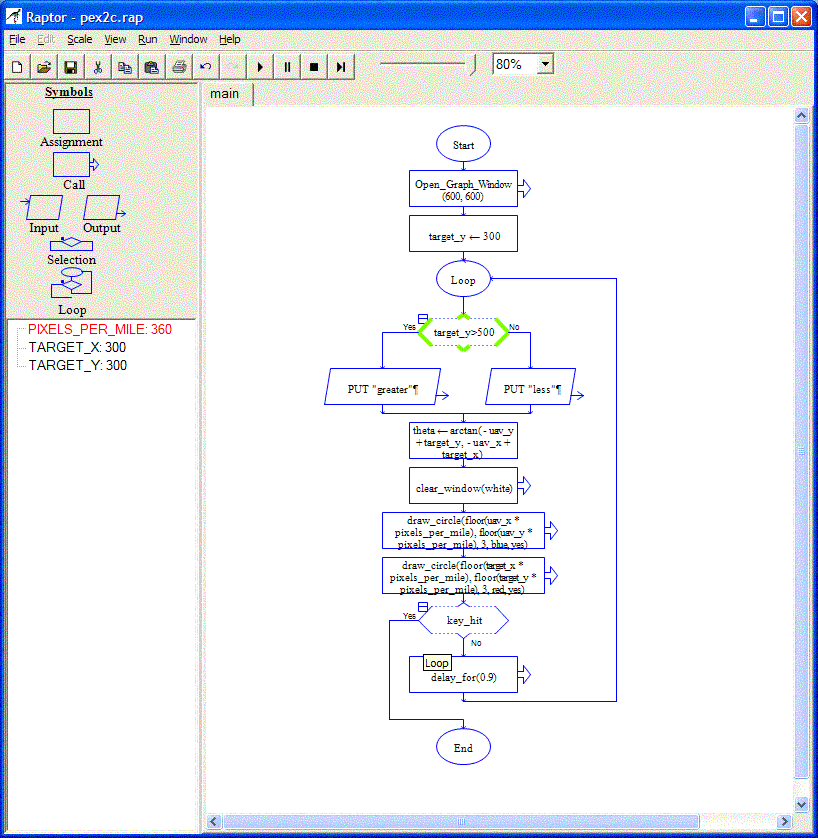
Figure 1 RAPTOR for Windows

Figure 2 RAPTOR Avalonia
Papers on RAPTOR application:
RAPTOR references
RAPTOR referenced in following books or publications:
- [view] An Introduction to Programming and Algorithmic Reasoning using RAPTOR (Hadfield, Weingart and Brown)
- [view] Starting Out with Programming Logic & Design (Tony Gaddis)
- [view] Prelude to Programming Concepts and Design (Venit and Drake)
- [view] School-based ICT (Longman Computer Course for Junior Secondary) (English and Chinese versions)
- [view] Introducción a la programación, Algoritmos y su implementación en VB.NET, C#, Java y C++
- books from Tsinghua University Press:
- [view] Visualized Computing 2012
- [view] Visualized Computing based On RAPTOR case tutorial 2014
- [view] RAPTOR programming case tutorial
The Mysterious Case of Lovita's Fate: Unraveling the Enigma
The late-November window in 2025 is dominated by blockbusters and critical darlings competing for end-of-year acclaim. Wicked: For Good
Without more context, I can’t assess quality, intent, or value. Please provide the actual item or media you want reviewed.
- The Blackout: On social media platforms, partnered influencers and official brand accounts post a single black image with the timestamp "23:11" or the date "23/11," then go silent for 24 hours.
- The Glitch: Posters in major cities (IRL - In Real Life) would feature QR codes that only work when scanned at exactly 11 minutes past the hour, revealing snippets of the lore.
- Viral Challenge: Encouraging users to "Freeze" their feeds—posting a photo or video of a moment they wish they could keep frozen forever, tagged with #Freeze23
Lovita Fate owned a small shop at the corner of 23rd and 11th—numbered in the old way the city still remembered: 23 | 11 | 17. The brass numbers on her door had been hammered by her grandfather, who once said a person’s address could be a prophecy if you listened close. Lovita sold things people couldn’t get anywhere else: salvaged radios that hummed forgotten songs, jars of “summer-smell” candle wax that, when burned, made you feel as if you were standing barefoot on sun-warmed flagstones. Her sign read TALK TO ME in faded neon, part invitation, part warning.
She thought of her grandfather and the brass numbers and the way Fate had turned a prophecy into a marketplace of choices. Lovita smiled and said, “I listen for what’s missing. Then I sell what helps people find their way.”
RAPTOR Avalonia Common issues
Hot Hot Freeze 23 11 17 Lovita Fate Talk To Me Xxx 1080 ((full)) [ OFFICIAL ]
The Mysterious Case of Lovita's Fate: Unraveling the Enigma
The late-November window in 2025 is dominated by blockbusters and critical darlings competing for end-of-year acclaim. Wicked: For Good hot hot freeze 23 11 17 lovita fate talk to me xxx 1080
Without more context, I can’t assess quality, intent, or value. Please provide the actual item or media you want reviewed. The Mysterious Case of Lovita's Fate: Unraveling the
- The Blackout: On social media platforms, partnered influencers and official brand accounts post a single black image with the timestamp "23:11" or the date "23/11," then go silent for 24 hours.
- The Glitch: Posters in major cities (IRL - In Real Life) would feature QR codes that only work when scanned at exactly 11 minutes past the hour, revealing snippets of the lore.
- Viral Challenge: Encouraging users to "Freeze" their feeds—posting a photo or video of a moment they wish they could keep frozen forever, tagged with #Freeze23
Lovita Fate owned a small shop at the corner of 23rd and 11th—numbered in the old way the city still remembered: 23 | 11 | 17. The brass numbers on her door had been hammered by her grandfather, who once said a person’s address could be a prophecy if you listened close. Lovita sold things people couldn’t get anywhere else: salvaged radios that hummed forgotten songs, jars of “summer-smell” candle wax that, when burned, made you feel as if you were standing barefoot on sun-warmed flagstones. Her sign read TALK TO ME in faded neon, part invitation, part warning. Lovita Fate owned a small shop at the
She thought of her grandfather and the brass numbers and the way Fate had turned a prophecy into a marketplace of choices. Lovita smiled and said, “I listen for what’s missing. Then I sell what helps people find their way.”
About Windows RAPTOR Modes
Did you know RAPTOR has modes? By default, you start in Novice mode. Novice mode has a single global namespace for variables. Intermediate mode allows you to create procedures that have their own scope (introducing the notion of parameter passing and supports recursion). Object-Oriented mode is new (in the Summer 2009 version)
RAPTOR is Free!
RAPTOR is freely distributed as a service to the CS education community. RAPTOR was originally developed by and for the US Air Force Academy, but its use has spread and RAPTOR is now used for CS education in over 30 countries on at least 4 continents. Martin Carlisle is the primary maintainer, and is a professor at Texas A&M University.
Authors
Avalonia Edition
Windows Edition
Feedback
Comments, suggestions, and bug reports are welcome. If you have a comment, suggestion or bug report, send an email to .
Forum
David Cox has put together a user forum at http://raptorflowchart.freeforums.org. This provides a place for users to exchange ideas, how tos, etc. Note however, that feedback for the author should be sent by email rather than posting on this forum.
Youtube Videos
Randy Bower has some YouTube tutorials at http://www.youtube.com/user/RandallBower. You can also search YouTube for "RAPTOR flowchart".
Acknowledgements
The UML designer is based on NClass, an open-source UML Class Designer. NClass is licensed under the GNU General Public License. The rest of RAPTOR, by US Air Force policy, is public domain. Source is found here. RAPTOR is written in a combination of A# and C#. Unfortunately, I don't have the time to provide support on compilation issues